A wedding invitation is not merely a request for attendance. It is the first impression of the celebration itself -- a tangible expression of the couple's values, aesthetic, and reverence for the occasion. In a world of digital shortcuts and casual communication, the formal wedding invitation remains one of the last truly sacred social traditions. To receive one is an honor. To send one is an art.
The Anatomy of a Proper Invitation
A refined wedding invitation speaks in a language of its own. Every element -- from the weight of the paper to the curve of the script -- communicates something about the couple and the event they are hosting. The finest invitations are not loud. They are quietly extraordinary.
"An invitation should feel like a privilege the moment it is removed from the envelope -- something to be held, admired, and honored."
The essential components of a formal wedding invitation include:
- The host line -- traditionally the parents of the bride, though modern invitations may name both sets of parents or the couple themselves
- The request line -- "request the honour of your presence" for religious ceremonies; "request the pleasure of your company" for secular celebrations
- The couple's names -- presented with care and hierarchy, the bride's name traditionally appearing first
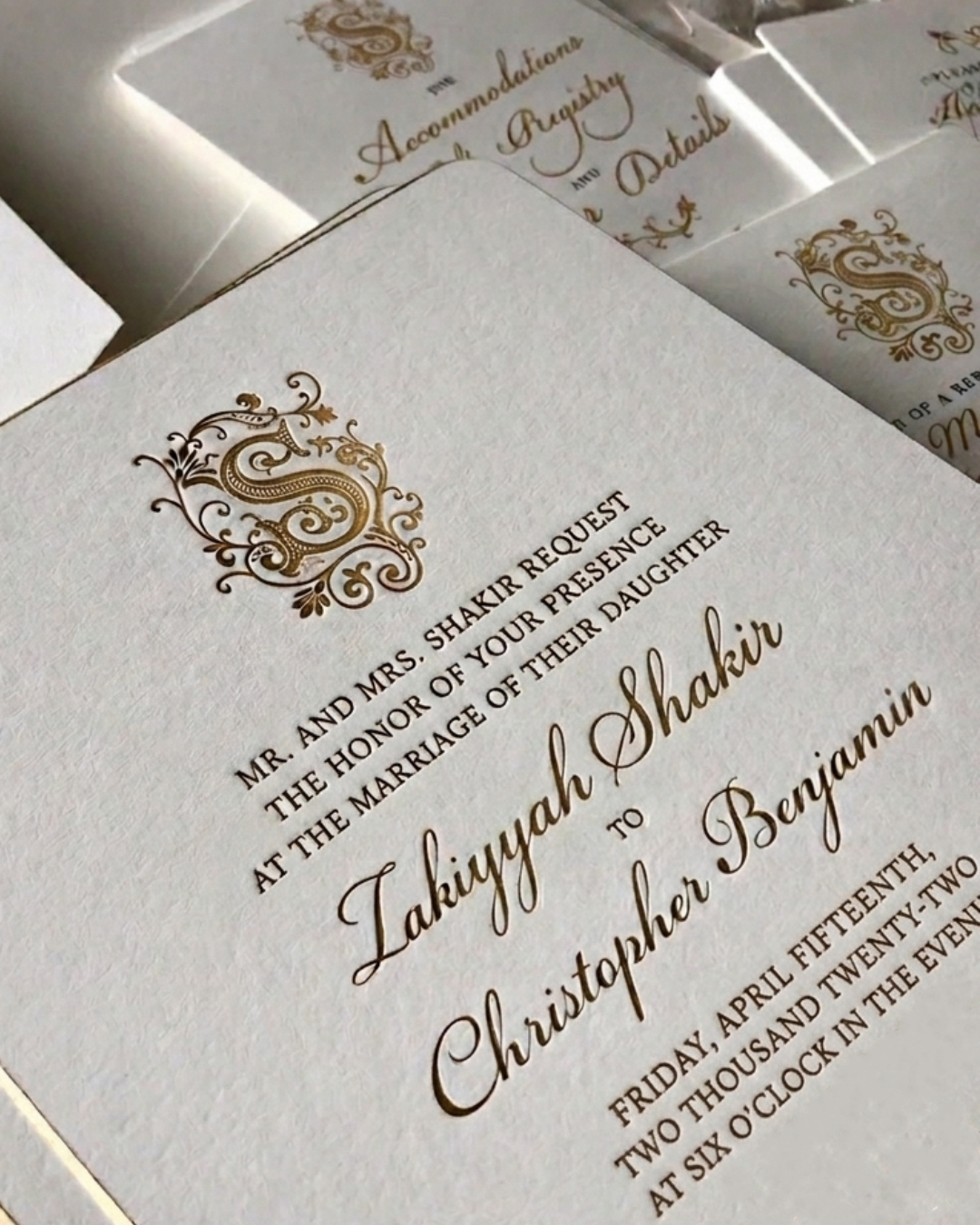
- The date and time -- spelled out in full, never abbreviated. "Friday, the fifteenth of April, two thousand and twenty-two, at six o'clock in the evening"
- The venue -- with full address, no abbreviations
- The reception line -- a gracious transition from ceremony to celebration
Paper, Print, and the Power of Touch
The most exquisite invitations engage the senses before a single word is read. The texture of cotton paper, the slight impression of letterpress, the luminous warmth of gold foil -- these are not indulgences. They are statements of intention.
Letterpress printing creates a subtle debossed impression that you can feel with your fingertips. Foil stamping in gold or copper adds warmth and formality. Engraving -- the most traditional and prestigious method -- produces raised lettering from an etched copper plate. Each method carries its own quiet dignity.
The paper itself matters profoundly. Cotton paper, with its soft weight and natural texture, communicates permanence. It tells the recipient: this occasion is worthy of something that endures.
The Art of the Monogram and Crest
A custom monogram or family crest elevates an invitation from beautiful to heirloom. Positioned at the top of the invitation, it serves as a visual signature -- a mark of identity that unifies the entire stationery suite. The finest monograms are intricate without being cluttered, ornate without being ostentatious. They balance tradition with personality.
A well-designed crest can carry through the entire wedding experience: from the invitation and response card to the ceremony program, menu cards, and even the couple's future personal stationery.
The Envelope: Your First Impression
Before the invitation is even seen, the envelope sets the tone. Proper wedding invitation etiquette calls for two envelopes:
- The outer envelope -- addressed formally with full titles and names. No abbreviations. No labels. Hand-addressed or professionally calligraphed
- The inner envelope -- a more intimate address that specifies exactly who is invited. "Mr. and Mrs. Benjamin" on the outer becomes "Christopher and Zakiyyah" on the inner
The return address appears on the back flap of the outer envelope -- never on the front. This small detail speaks volumes about your attention to tradition.
What Most People Get Wrong
Even well-intentioned hosts make common missteps that diminish the elegance of their invitation:
- Abbreviations -- "St." instead of "Street," "Dr." instead of "Doctor." In formal invitations, everything is spelled out completely
- Digital RSVPs -- while convenient, a formal invitation deserves a formal response card with a stamped return envelope. If you must include a website, place it on a separate enclosure card -- never on the invitation itself
- Registry information on the invitation -- this is perhaps the most common breach. Gift information should never appear on the invitation. It may be shared by word of mouth, on a wedding website, or on a separate enclosure card within the suite
- "And Guest" -- whenever possible, learn the name of your guest's companion and address them by name. "And Guest" is acceptable only when the companion is unknown
- Casual language -- phrases like "Join us!" or "Party starts at 7!" have no place on a formal wedding invitation, regardless of how relaxed the celebration may be
The Response: An Obligation, Not an Option
If you are fortunate enough to receive a wedding invitation, your response is not optional -- it is a social obligation. Respond within one week of receiving the invitation. Use the response card provided. If the card reads "M________," write your title and name on the line: "Mr. Andrew Sanders." Check the appropriate attendance line. Return it promptly in the envelope provided.
If no response card is included (as was traditional in the most formal invitations), write a handwritten note on your personal stationery accepting or declining the invitation. Mirror the language and formality of the invitation you received.
"The speed and grace of your response reflects the depth of your respect for the host."
The Enclosure Cards
A complete wedding invitation suite is a curated collection of information, each piece serving a distinct purpose:
- The response card and envelope -- pre-stamped, pre-addressed, requiring only the guest's name and attendance
- The reception card -- if the reception is at a different location than the ceremony
- The accommodations card -- hotel blocks, transportation details, and weekend event information
- The details card -- dress code, parking, wedding website, or any additional guidance
Each card should match the design language of the invitation -- same paper, same typography, same quiet excellence.
Timing Is Everything
Save-the-dates should arrive six to eight months before the wedding -- earlier for destination celebrations. The formal invitation should be mailed six to eight weeks before the wedding date, with an RSVP deadline of three to four weeks prior. This gives the couple sufficient time to finalize seating, catering, and all the details that depend on an accurate headcount.
Mail invitations on a Tuesday or Wednesday so they arrive mid-week -- never buried in weekend junk mail. First impressions matter, even in the mailbox.
The Digital Question
In our modern age, the question inevitably arises: is a digital invitation ever appropriate for a wedding? The answer depends entirely on the formality of the occasion. For an intimate elopement celebration or a casual gathering of close friends, a beautifully designed digital invitation may suffice. But for a formal wedding -- one that asks guests to dress, travel, and celebrate with intention -- the printed invitation remains irreplaceable.
There is something profoundly human about holding an invitation in your hands. It engages the senses in a way no screen can replicate. It becomes a keepsake. And in its very physicality, it communicates: this moment matters enough to be made tangible.
A Final Word on Grace
Whether you are the one sending or receiving, remember that a wedding invitation is ultimately an expression of love made visible. It deserves to be crafted with care and received with gratitude. The invitation sets the stage for everything that follows -- and when it is done with excellence, it becomes the first beautiful memory of a day that will be remembered for a lifetime.
—Mrs. Zakiyyah Benjamin
Founder, Peerless Etiquette
Where True Refinement Is Unmatched